Building the Concrete Backbone of India’s Infrastructure: Venus Techno Equipment’s Batching Plant Solutions for a Growing Nation
Venus Techno Equipment Pvt. Ltd. is a leading Indian manufacturer of concrete batching plants and construction equipment, offering innovative stationary, mobile, compact, and eco-series solutions for diverse infrastructure projects. With decades of expertise, advanced automation, and application-specific engineering, the company enables efficient, reliable, and high-quality concrete production for highways, metros, bridges, industrial developments, and urban infrastructure.
Building the Concrete Backbone of India’s Infrastructure: Venus Techno Equipment’s Batching Plant Solutions for a Growing Nation
India is building at a scale that demands a new way of thinking about construction.
The country's infrastructure landscape is changing rapidly. Highways are expanding, expressways are connecting major economic centres, metro networks are transforming urban mobility, industrial corridors are creating new centres of economic activity, and large-scale residential and commercial developments are reshaping cities.
Behind every kilometre of highway, every bridge, every flyover, every metro viaduct and every major concrete structure lies an enormous requirement for one of the world's most fundamental construction materials: concrete.
But concrete does not simply arrive at a construction site.
It has to be produced with precision, in the right quantity, at the right time, and increasingly, at the right location.
This is where the concrete batching plant becomes critical.
A batching plant is often one of the least visible components of a major construction project, yet it is one of the most important. It is the point where raw materials are accurately measured, proportioned, mixed and transformed into the concrete required to build the infrastructure around us.
As India's infrastructure ambitions grow, the expectations placed on batching plants are changing as well. The industry needs solutions that can produce concrete consistently, operate efficiently, adapt to different site conditions and support increasingly demanding project schedules.
For Venus Techno Equipment Pvt. Ltd., this is not a new challenge.
With roots in the construction equipment industry going back to 1992, and Venus Techno Equipment established in 2000, the company has spent decades developing its expertise in concrete equipment, manufacturing, research and development, and precision fabrication. Today, Venus has built a portfolio of concrete batching solutions designed around one central understanding: different projects require different approaches to concrete production.
India's Infrastructure Growth Is Creating a New Demand for Concrete Production
The scale of India's infrastructure development provides the backdrop against which the concrete equipment industry is evolving.
India's National Highway network has expanded from 91,287 km in 2014 to 1,46,572 km by March 2026. Four-lane-and-above National Highways have increased from 18,371 km to 45,516 km, while 3,644 km of access-controlled high-speed corridors and expressways have been operationalised.
The implication for construction equipment manufacturers is significant.
Modern infrastructure projects require enormous volumes of materials, but they also require those materials to be produced and delivered with increasing precision and efficiency.
A highway project may extend over several kilometres.
A bridge may require continuous concrete supply for critical structural elements.
A metro project may involve multiple construction zones operating simultaneously.
An urban project may have limited space for equipment.
A remote infrastructure project may have no convenient access to an established ready-mix supply chain.
These different scenarios require different concrete production strategies.
This is why the future of concrete batching is not simply about increasing output.
It is about matching the production system to the project.
Venus's batching plant portfolio has been developed around this principle, covering stationary, mobile, ECO mobile and compact concrete batching solutions.
VIST Series: High-Performance Concrete Production for Demanding Projects
For large infrastructure and long-duration construction projects, consistency of concrete production is fundamental.
When a project requires substantial volumes of concrete over an extended period, a stationary batching plant can become the central production hub around which the concrete supply chain is organised.
Venus's VIST Series Stationary Concrete Batching Plants are designed for this category of application.
The range includes models designed for different production requirements, with the VIST 60 offering a stated output capacity of 60 m³/hr and the VIST 90 offering up to 90 m³/hr. The plants are available with mixer configurations including twin-shaft and pan mixer options, and feature digital load-cell weighing systems and PLC-based control systems.
These features are important because large-scale concrete production is fundamentally about control.
Every batch must contain the correct proportions of aggregates, cement, water and admixtures. The more concrete a project produces, the more important consistency becomes.
The VIST Series incorporates digital load-cell-based weighing, enabling the separate measurement of key materials, while PLC-based control helps automate and coordinate the batching process. The VIST 60, for example, offers material storage capacities listed at 40/60 m³, while the VIST 90 is listed with 90 m³ of material storage capacity.
For infrastructure projects, this combination of production capacity, controlled batching and automation can be particularly relevant.
The objective is not merely to produce more concrete.
It is to produce consistent concrete, batch after batch, while maintaining control over the production process.
This makes the VIST Series relevant to applications such as major infrastructure, precast operations and large construction projects where concrete demand is sustained and production continuity is critical.
CCP Series: Mobile Concrete Production for Projects That Move
India's infrastructure development is increasingly characterised by linear projects.
Highways, expressways, rail corridors and canals can extend across considerable distances.
In these projects, the location of active construction is constantly changing.
A stationary concrete production facility may not always be the most efficient answer.
This is where mobility becomes important.
Venus's CCP Series Mobile Concrete Batching Plants are designed to bring concrete production closer to projects where mobility and flexibility are key considerations.
The CCP 30, for example, has a listed output capacity of 30 m³/hr and features a 2 × 2 cross-bin material storage system with a listed capacity of 14 m³. Its weighing system uses digital load cells for separate weighing of aggregates, cement, water and additives, while its control system is based on PLC technology. Venus also lists mixer options including pan, planetary and twin-shaft configurations for the CCP 30.
The value of such a system goes beyond simply being "mobile."
Mobility can influence the logistics of concrete production.
When a project progresses from one location to another, the ability to establish production closer to the active work zone can help reduce the dependence on long-distance concrete transportation.
This can be particularly relevant for road and infrastructure projects where construction activity moves progressively along a corridor.
The CCP Series therefore represents an important part of Venus's approach: bringing production capability closer to where infrastructure is being built.
ECO Series: Compact Mobility for Flexible Project Requirements
Not every project requires the production capacity or infrastructure of a large stationary batching plant.
Some projects have lower or medium concrete demand. Others may be temporary, geographically dispersed or require frequent relocation.
For these applications, the Venus ECO Series Mobile Concrete Batching Plants offer a different approach.
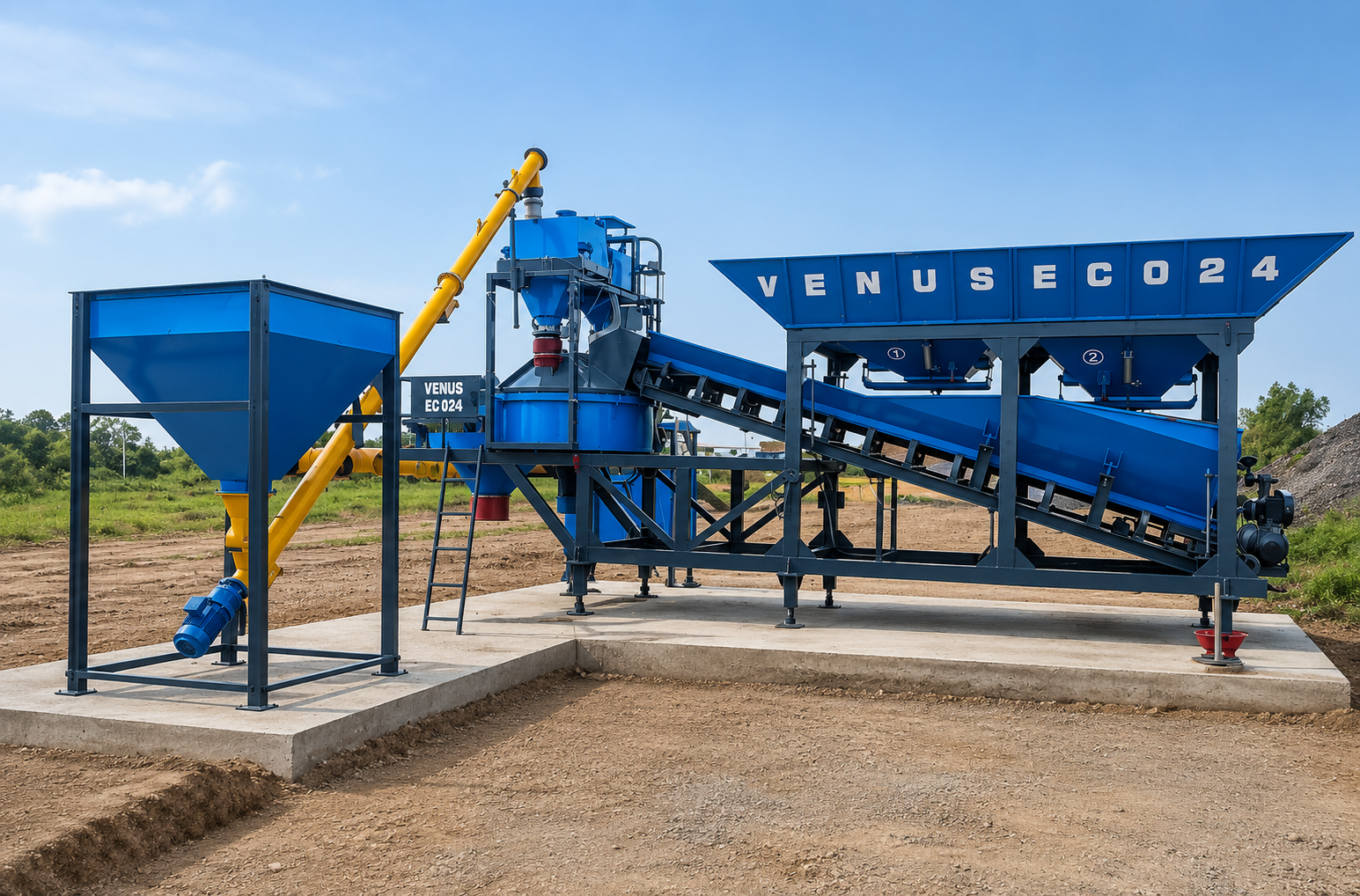
The ECO range includes the ECO 18, ECO 25 and ECO 30, with listed theoretical output capacities of approximately 18, 25 and 30 m³/hr, respectively.
The ECO 18, for instance, is designed as a portable concrete production solution integrating storage, weighing, conveying, mixing and discharging into a compact system. Venus states that it can be transported with a single trailer and is designed for applications where mobility and relatively lower concrete demand are important considerations.
The ECO 30 follows the same philosophy at a higher capacity, with a listed theoretical output of 30 m³/hr, digital load-cell-based weighing systems and PLC-based controls.
For contractors, this type of solution can be particularly relevant when the project requires flexibility without committing to a large permanent production setup.
The value lies in the balance between mobility, compactness and production capability.
CP Series: When Space Is as Important as Production
India's construction growth is not limited to highways and open infrastructure corridors.
A significant amount of construction activity is taking place inside cities.
Metro projects, commercial buildings, residential developments, redevelopment projects and urban infrastructure often operate under challenging space constraints.
In such environments, the physical footprint of a batching plant becomes an important consideration.
Venus's CP Series Compact Concrete Batching Plants are designed to address this requirement.
The CP 60, for example, is listed with a theoretical output of 60 m³/hr and offers twin-shaft and pan mixer options. Its compact 2 × 2 cross-bin configuration provides 30 m³ of material storage capacity, while its material weighing system uses separate digital load-cell weighing for aggregates, cement, water and additives. The plant also features a SCADA-based control system, providing a more advanced level of monitoring and control.
The significance of a compact plant is therefore not simply that it occupies less space.
It is about creating an efficient production solution where site constraints would otherwise make conventional plant configurations difficult.
For India's increasingly dense urban construction environment, this flexibility can be valuable.
The Technology Behind Venus Batching Plants
Across the different Venus batching plant categories, several common engineering principles emerge.
The first is accuracy.
Concrete quality depends heavily on the proportions of its constituent materials. Venus's batching plants use digital load-cell-based weighing systems for controlled measurement of aggregates and other key ingredients.
The second is automation.
PLC-based control systems are incorporated across several Venus plant configurations, while the CP 60 offers SCADA-based control. These systems help operators manage batching sequences, material dosing and production processes more systematically.
The third is mixer flexibility.
Depending on the model and application, Venus offers mixer configurations including pan, planetary and twin-shaft options. This allows the batching plant to be configured according to the requirements of different concrete production applications.
The fourth is material management.
A batching plant is not just a mixer. It is an integrated system involving aggregate storage, cement and filler handling, water and admixture dosing, conveyors, weighing systems and controls.
Venus's wider concrete equipment portfolio also includes horizontal and vertical cement and fly ash silos, enabling customers to develop more complete concrete production systems.
Together, these elements determine the real performance of a batching plant.
One Portfolio, Different Project Realities
The strength of Venus's batching plant offering lies in the breadth of its portfolio.
A contractor executing a large infrastructure project may require the production capacity and continuity of a VIST stationary plant.
A highway contractor working across a moving project corridor may benefit from the mobility of a CCP mobile plant.
A contractor working on shorter-duration or lower-demand projects may find the ECO Series better suited to its requirements.
An urban construction project operating under tight space constraints may benefit from a CP compact plant.
This is an important distinction.
There is no universal "best" batching plant.
The best plant is the one that is correctly matched to the project's production requirements, logistics, location, available space and operating environment.
This application-focused approach is central to Venus's position in the concrete equipment segment.
The company's objective is not simply to manufacture one category of batching plant.
It is to provide a portfolio capable of addressing the diversity of India's construction landscape.
From Equipment Manufacturer to Concrete Production Partner
Venus's batching plant expertise is supported by a broader construction equipment ecosystem.
The company's portfolio extends beyond batching plants to include stationary concrete pumps, self-loading mixers, transit mixers, reversible mixers, concrete pavers and cement storage silos, among other equipment.
This broader understanding of concrete production is important.
A batching plant does not operate in isolation.
Concrete must be produced.
It must then be transported.
It must be placed.
And ultimately, it must become part of the structure being built.
By developing capabilities across multiple stages of this process, Venus has positioned itself to understand concrete production not simply as an individual machine, but as part of a larger construction workflow.
The company's website states that it has more than three decades of expertise, a machine population of more than 5,000, 24×7 service support and exports to more than 15 countries. It also positions Venus as an Indian manufacturer of concrete and asphalt equipment serving applications ranging from urban roads and highways to flyovers, bridges, railways, solar and wind projects.
These figures provide context to the company's evolution from an equipment manufacturer into an established participant in the wider concrete and infrastructure equipment ecosystem.
The Road Ahead: More Concrete, More Control, More Efficiency
India's infrastructure growth will continue to create demand for concrete.
But the future will not be defined by volume alone.
As projects become larger and more technically demanding, contractors will increasingly look for equipment that offers better control over production, improved reliability, greater flexibility and more efficient use of resources.
This will place greater importance on automation, digital controls, accurate weighing, efficient mixing and data-driven production management.
For batching plant manufacturers, the challenge will be to ensure that technology remains practical and directly connected to customer needs.
Venus's portfolio reflects this direction.
From the high-capacity VIST Series to the mobile CCP and ECO solutions and the space-efficient CP Series, the company has developed a range of batching plants designed around different project realities.
That is perhaps the most important lesson from India's infrastructure expansion.
The country is not building one type of infrastructure.
It is building many.
And the equipment supporting that development must be equally diverse.
A highway needs a different concrete production strategy from a high-rise.
A remote bridge project may need a different solution from a permanent ready-mix operation.
A metro project in a dense urban environment may have completely different site constraints from a large industrial development.
The future therefore belongs to manufacturers that can combine engineering expertise with application understanding.
Engineering the Concrete Behind India's Growth
India's infrastructure story is often told through kilometres of highways, kilometres of metro lines, numbers of bridges, or the scale of investment.
But behind every number is a construction process.
And behind that process is equipment.
Concrete batching plants are a critical part of that equipment ecosystem.
They determine how raw materials are transformed into the concrete that ultimately becomes bridges, foundations, structures, pavements and infrastructure.
Venus Techno Equipment's role in this ecosystem is to develop batching solutions that respond to the different ways India is building.
The VIST Series supports projects where production capacity and continuity are essential.
The CCP Series brings mobility into concrete production.
The ECO Series provides compact and flexible mobile solutions.
The CP Series addresses projects where space efficiency and production capability must work together.
Across these solutions, the focus remains on the fundamentals that matter to customers: accurate batching, consistent mixing, automation, efficient material handling, reliable operation and application-specific engineering.
As India continues to invest in highways, expressways, metro systems, bridges, industrial corridors and urban infrastructure, the demand for efficient concrete production will only become more important.
For Venus, the opportunity is not simply to supply another machine to a construction site.
It is to provide the equipment that becomes part of the infrastructure-building process itself.
Because before concrete becomes a bridge, a highway, a metro viaduct or a building, it must first be produced.
And increasingly, the quality, efficiency and reliability of that production begin with the right batching plant.
Venus Techno Equipment Pvt. Ltd.
Engineering Concrete. Enabling Infrastructure.